OUR SErVICE VISION
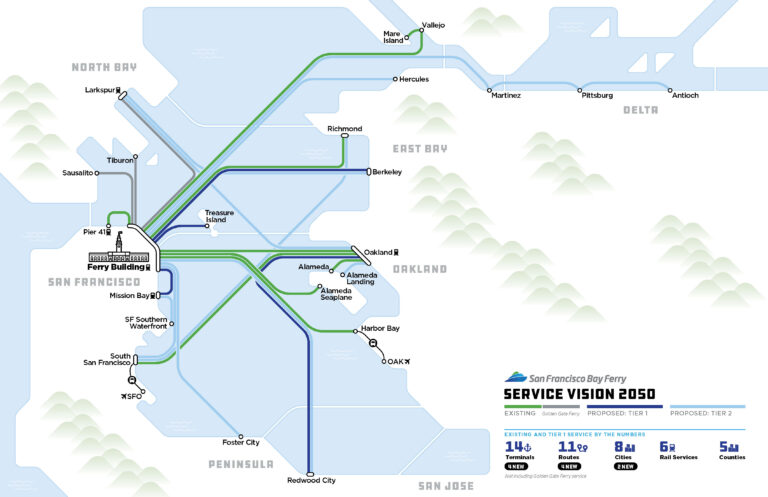
Our vision for the future, as set forth in the 2050 Service Vision includes stronger ferry networks that are sustainable, accessible, and built for resilience in the face of a changing climate, as incorporated by the 4Es.
The 2050 Service Vision is grounded in four key priorities — the “4 E’s”: Enhance, Expand, Electrify, and Emergency Response. These pillars guide our approach to growing a ferry system that is regionally connected, socially equitable, and environmentally sustainable.
- Enhance: Increase service on existing routes to provide more flexibility for riders and meet growing demand.
- Expand: Add new routes that connect underserved and growing communities across the Bay.
- Electrify: Transition to a 100% zero-emission fleet, upgrading terminals and infrastructure along the way.
- Emergency Response: Strengthen SF Bay Ferry’s emergency operations with more vessels, more seats, and improved network readiness
Current Expansion Projects
ENHANCE
The SF Bay Ferry enhancement will benefit 2.7 million residents with increased service frequencies, offering 20–30 minute headways on most ferry routes during peak hours. By incrementally adding new services between core terminals, this will prioritize routes exhibiting the strongest market potential. The ferry system will offer three primary types of service: local service connecting dense urban hubs, regional service linking major activity centers over medium to long distances, and special event service to venues with existing terminals. The plan also emphasizes increasing midday, evening, and weekend service to provide consistent, all-day, every-day availability. Additionally, the enhancement of the core network will expand the system’s emergency response capabilities, increasing both reach and capacity.
EXPAND
The SF Bay Ferry expansion will connect 25% more residents and jobs to ferry service, expanding to 14 routes that link communities across the Bay Area. Key strategies include expanding service frequency on existing routes to support all-day ridership, implementing regional priority projects aligned with Plan Bay Area—such as connections from Mission Bay and Treasure Island to the Ferry Building, Berkeley to San Francisco, and Oakland to Redwood City—and exploring innovative service models like short-hop routes within cities such as San Francisco, Oakland/Alameda, and Vallejo/Mare Island.
ELECTRIFY
The SF Bay Ferry electrification will create the nation’s first 100% electrified ferry system, preventing 38,000 tons of carbon emissions annually. For example, SF Bay Ferry’s Rapid Electric Emission-Free Ferry (REEF) Program is a transformative suite of projects to transition our fleet to zero-emission propulsion technology. The program includes the electrification of our ferry floats and the development of the nation’s first high-speed, high-capacity zero-emission vessels.
Current Electrification Projects
EMERGENCY RESPONSE
The SF Bay Ferry enhancement will boost emergency preparedness with a 61% increase in evacuation capacity across the system. San Francisco Bay Ferry serves as the coordinator of water-based emergency response activities in the Bay Area in the event of a major disaster or disruptive event. In this capacity, San Francisco Bay Ferry will work closely with the California Office of Emergency Services and will be directed to perform activities coordinated on a regional and state-wide basis. All new expansion terminals will be designed and built to Essential Facilities Standards. Emergency service to individual terminals will be guided based on state and regional direction.
DRAFT BUSINESS PLAN
The SF Bay Ferry will soon release a draft of its 2050 Business Plan, which focuses on ferry service expansion, emergency response, environmental sustainability, and more.
The “Bay Ferry 2050” project has been a visioning effort to reimagine the ferry system in the Bay Area looking ahead to 2050, including its service level and emergency response capabilities. The Business Plan details the specific steps to make this vision a reality. To develop the vision and inform the draft Business Plan, SF Bay Ferry has been engaging the public and stakeholders through advisory groups, online surveys, and stakeholder meetings since the project kicked off in November 2021.
When published, the Draft Business Plan will be available here.
Key Areas of SF Bay Ferry’s Draft Business Plan include:
- Service Vision: The SF Bay Ferry 2050 Service Vision will grow the ferry network to improve regional mobility, emergency response, and community connections in an equitable, environmentally sustainable, and fiscally responsible manner.
- Service Expansion: The Service Vision will be implemented incrementally, prioritizing zero-emission vessels, transit-supportive land use, robust service levels, fare consistency, emergency readiness, and terminal access improvements aligned with environmental and operational standards.
- Pilot Program: The SF Bay Ferry launched a pilot program in 2023 to test emerging technologies and routes, and is evaluating their potential to meet future service standards and support full system ferry integration.
- Partnerships With Jurisdictions: SF Bay Ferry will partner with local jurisdictions via Memorandums of Understandings (MOUs) to fund and implement service expansion and ensure long-term financial sustainability, shared responsibilities, and adequate facilities, vessels, and terminal infrastructure.
- Implementation: SF Bay Ferry will finalize the 2050 Business Plan, build organizational capacity, engage stakeholders, and secure funding to effectively implement the Service Vision to support long-term growth.
- Periodic Updates: SF Bay Ferry will update the Service Vision every five years (or sooner) if significant changes arise that affect the scope of the draft plan.
Recent Draft Plan Updates to expansion, electrification, and service enhancement:
- Zero-emission vessel transition: SF Bay Ferry’s zero-emission transition includes piloting new technologies, electrifying short/medium routes, upgrading terminals, coordinating with utilities, managing electricity costs, and navigating complex permitting while maintaining operations goals.
- Land use and terminal access: Improving terminal access through bike, pedestrian, and bus connections, along with promoting transit-oriented land use to boost ridership and support SF Bay Ferry’s vision of reduced car reliance.
- Ridership and travel behavior: Recovering ridership post-pandemic, increasing commute access through weekend/non-commute service, targeting transit gaps amid uncertain return-to-office, ride-hailing competition, and rail expansions.
- Climate change: Enhancing climate and seismic resilience through adaptable terminals, disaster-ready infrastructure, and sustainability practices to combat weather events, sea level rise, and earthquakes.
- Financial considerations: The SF Bay Ferry is adapting its financial model to ensure long-term sustainability amid changing travel patterns, rising costs, and ambitious service goals. Historically dependent on passenger fares, the agency shifted during the COVID-19 pandemic to lower fares and more equitable access, now relying increasingly on non-fare revenue sources like regional bridge toll funds. This change supports expanded ridership but presents fiscal challenges as construction and labor costs rise, particularly with plans to transition to a zero-emission fleet and introduce new routes. Looking forward, the agency aims to boost fare revenue through increased ridership, secure alternative funding—including public-private partnerships and future ballot measures—and continually adapt service to meet the region’s evolving transportation needs.
How to Stay Updated:
Check the SF Bay Ferry website for updates on the agency’s plans and activities and sign up for the mailing list here.
Follow SF Bay Ferry on social media:
Participate in public meetings to stay informed.
SERVICE VISION FOCUS AREAS
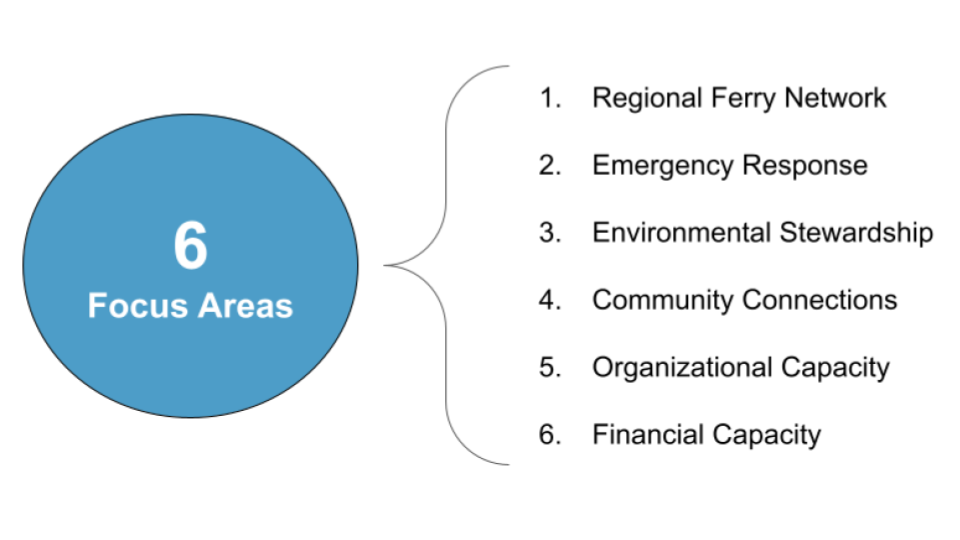
Through extensive community and stakeholder engagement from 2021 – 2024, the public and key stakeholders coalesced around six key focus areas to guide the 2050 Business Plan. These focus areas will provide a foundation for the Business Plan.
-
Page last updated: 24 May 2024, 09:22 AM
WHAT WE'VE HEARD SO FAR
Phase 1: Service Vision
From 2021 – 2023, SF Bay Ferry conducted community engagement to understand the priorities of key stakeholders and the Bay Area public for future ferry service. Engagement to date has included: 3 meetings of a community advisory group and a business advisory group, 2 WETA Board workshops, a public online poll, a public online survey, 9 community based organization (CBO) listening sessions, and 6 county working groups.
These engagements informed the development of a series of ferry service visions that were then evaluated against a set of possible futures, and ultimately helped to shape the Service Vision and Focus Areas. This approach to planning helps ensure Bay Area ferry service is responsive to public needs and resilient to whatever the future may hold.
Here’s what we heard about community priorities for the future of ferry service:
- Routes that bring in the most riders and routes that expand ferry connections to new parts of the region.
- All-day service options that accommodate non-traditional work and life schedules, while maintaining core service during peak work commute hours.
- Easy, seamless access from ferry terminals to first and last mile transit connections, such as bikes, buses and light rail.
- Ferry expansion does not adversely affect wetlands and wildlife refuges.
- Electric ferries are used wherever possible.
We also heard the following ideas and considerations:
- Coordinate growth with other transit services & need for high-capacity transit in markets not previously served.
- Run pilot programs to test new routes, markets, vessel technology, and/or operating models.
- Ensure the existing system is financially sustainable for the future and find new funding sources for terminal upgrades.
- Consider smaller vessels or private operators for lower-demand routes.
Please read the following summaries and data snapshots for more detail on what we heard through the first few rounds of community engagement.
WETA Board Workshop
On April 17, 2023, SF Bay Ferry hosted a public Board of Directors’ workshop to to review the final evaluation results and discuss a proposal by staff for developing a final 2050 Service Vision.
On August 17, 2022, SF Bay Ferry hosted a public Board of Directors’ workshop to discuss and inform the development a final set of future service scenarios to be evaluated over the last four months of 2022.
Quick Priorities Poll
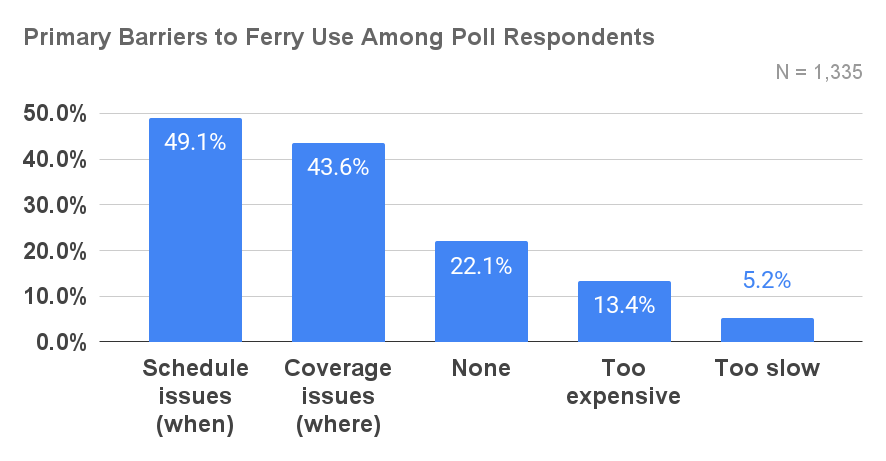
From July 11, 2022 through August 31, 2022, SF Bay Ferry asked members of the Bay Area public to share their priorities and preferences for future ferry service through a quick online poll on BayFerry2050.org. Responses reflect a desire for SF Bay Ferry to make changes to its service schedule and locations to grow future ridership (see chart below). For more information about what was shared, please review a full summary of the poll questions and responses from over 1,300 members of the Bay Area region.
Online Survey
From January 30, 2023 through March 24, 2023, SF Bay Ferry asked members of the Bay Area public to share their preferences for how the ferry system should balance affordability, service frequency and speed, expansion, and environmental sustainability through an online survey. The survey was promoted and distributed by a variety of ferry system partners and advocates across the region, including the offices of elected officials, through social media channels, and directly to current ferry riders. In total, 4,568 people from across the region completed the survey.
Key Takeaways:
When considering what factors impact someone’s decision to ride the ferry, SF Bay Ferry observed some consistent themes across the survey questions.
- Departure schedule / trip frequency was the predominant factor when deciding whether to ride the ferry. This was true across different use types (commute, recreation/leisure, other) and was true across all counties.
- Respondents also consistently prioritized the following:
- Connectedness/Alignment with other modes of transit
- The amount of time it takes to complete the trip.
- Cost of the ticket
Amenities and environmental impact had minimal effect on people’s decisions to ride the ferry, however, environmental conservation did rank more highly in terms of values/visions for the future of the ferry system.
When visioning SF Bay Ferry and water transportation in 2050, the top four outcomes that respondents prioritized were:
- Ridership. Ferries maximize ridership and provide competitive alternatives to driving.
- Service coverage. More people have access to ferry service.
- Redundancy. Ferries overlap with regional rail and bus services and provide an alternate transit option.
- Environmental conservation. Ferry expansion does not adversely affect wetlands and wildlife refuges.
Read the full report here.
A Few Personal Vision Statements from the Public:
Page last updated: 23 May 2024,
STAY UPDATED
Stay informed about the SF Bay Ferry 2050 Project, draft plan, and learn about upcoming opportunities.