


Over the past decade, San Francisco Bay Ferry has made waves in providing reliable, safe, and clean transportation options available to workers and riders across the region. Running a public ferry system is a highly collaborative effort, especially as the agency shares the state’s goals of reducing greenhouse gas emissions and implementing more socially, economically, and environmentally sustainable practices.
In a discussion with Timothy Hanners, SF Bay Ferry’s Director of Project Delivery and Engineering, he provided a glimpse into the multi-year process that precedes the introduction of new, cleaner vessels into the fleet. From detailed assessments of emissions reduction technology to long-term engagement with partners and stakeholders, the agency’s newest vessel, MV Karl, has been years in the making. “We’re always striving for the best available and cleanest technology,” Hanners shared. “As a public agency, we pursue funding opportunities and grant resources that allow us to bring new equipment into the Bay Area.”
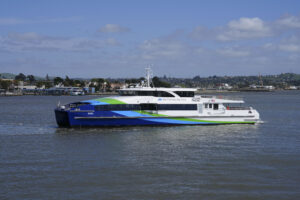
MV Karl is the cleanest diesel high-speed passenger ferry in the nation and the first delivered to meet the California Air Resource Board’s (CARB) new emissions limits for commercial harbor craft. The ferry is powered by four U.S. Environmental Protection Agency (EPA) Tier 4 engines supplied by MAN Engines and is equipped with diesel particulate filters (DPF), a first in the passenger ferry industry. MV Karl is among the last diesel vessels that will be added to the SF Bay Ferry Fleet.
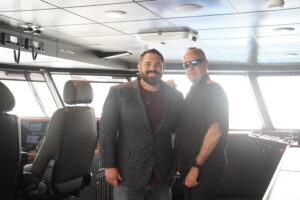
With new equipment comes updated training protocols implemented among captains and deckhands. Hanners detailed a few of the hands-on partnerships involving SF Bay Ferry’s contract operator, Blue & Gold Fleet. Most recently, senior captain Chuck Elles joined Hanners on the construction yard to provide direct feedback during MV Karl’s build. “We prioritize the standardization of vessels across the fleet because our captains and crew members may operate a different boat on any given day. Important details including the wheelhouse layout require the captain’s input because the controls must have a similar feel across our fleet,” Hanners shared.
The onboard passenger experience is also a key component of ferry innovation; Hanners shared that MV Karl’s increased indoor seating capacity is a direct result of feedback from passengers who routinely ride the system’s longer routes.
MV Karl will enter passenger service in the Bay’s waters this May, primarily on the Vallejo route. State and local officials joined SF Bay Ferry for a commissioning ceremony on April 25 during San Francisco Climate Week.
CARB recently approved SF Bay Ferry’s plan to accelerate adoption of zero-emission technology for new short-run and existing transbay routes. SF Bay Ferry’s first five battery-electric ferries are currently under construction, with the first vessel expected to be in service in early 2027.
Serving more than 2.5 million passengers per year, SF Bay Ferry’s daily operations and technological innovations emphasize how clean, reliable transit is a core part of ensuring regional connectivity among Bay Area residents. The agency’s strides toward a greener fleet and more sustainable system are also linked to critical conversations about the historical impact of transportation emissions, noise, and contamination among equity priority communities. [1]
With climate change setting an increasingly urgent tone, MV Karl joins the fleet in alignment with statewide efforts to reduce the emissions impact of the transportation sector in California. SF Bay Ferry, alongside multiple Bay Area transit agencies transitioning to greener fleets, continues to lead by example among marine and land-side transportation. The agency plans to grow the ferry network with the goal of cultivating community connections to vibrant economic hubs, promoting equitable access to local opportunities and advancing environmental sustainability in public transportation.